
Quick answer: What Google Pomelli does for your marketing
Google Pomelli is an experimental AI marketing tool from Google Labs and Google DeepMind that helps small and mid-sized businesses turn a website URL into ready-to-edit marketing campaigns. You sign in with your Google account, paste in your site, and Pomelli scans your pages and images to learn your brand’s tone of voice, colors, fonts, and visual style. It calls this profile your “Business DNA” and uses it to generate campaign ideas plus social-ready creatives that feel consistent with your existing brand.
Glossary:
- Google Pomelli: An AI-powered marketing assistant in Google Labs that generates campaign ideas, copy, and visual assets from your website.
- Business DNA: Pomelli’s internal profile of your brand, based on your site’s content, visuals, and design choices.
- Google Labs experiment: A public beta product that Google still treats as an experiment, so features and availability can evolve over time.
- Target user: Primarily small and mid-sized businesses that don’t have a big in-house creative team but still want on-brand content.
What is Google Pomelli and how does this AI marketing tool work?
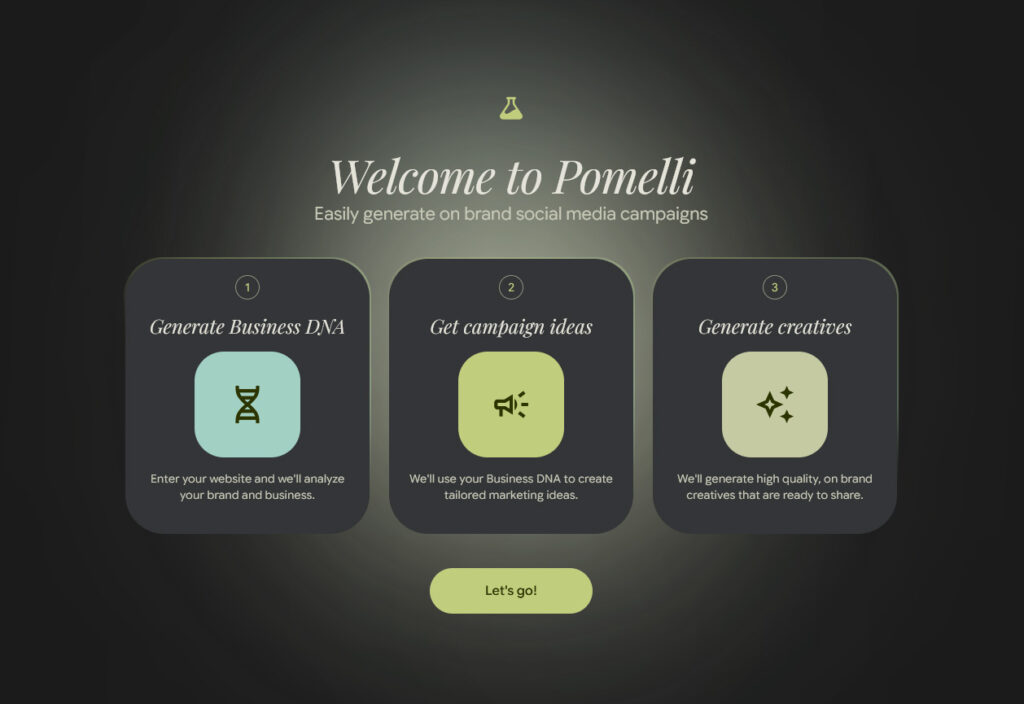
Google Pomelli is like a lightweight creative partner that sits between a generic AI text generator and a full agency. Google built it for teams that need branded marketing content but don’t have the time or budget to brief designers and copywriters for every small campaign.
Pomelli focuses on three core ideas.
- Learn your brand from your website
Instead of acting like a generic AI chatbot or making you upload document after document about your brand, Pomelli learns from the public website you already maintain. You give it your URL and, if you like, a small set of extra images. Pomelli analyzes the visuals and copy, then builds a Business DNA profile that should capture your tone, color palette, typography, and general visual style. - Generate campaign ideas instead of isolated posts
More generic AI tools spit out single posts that don’t connect to a larger story. Pomelli starts with campaign ideas that map to common goals such as awareness, promotion, or product education. You can pick from suggestions or type your own idea, then let Pomelli fill in a campaign with multiple posts, headlines, and visuals. - Output ready-to-edit assets for social and ads
Once you pick a direction, Pomelli generates sets of assets that you can review in one place. You see post copy, image layouts, and variations you can tweak inside the tool. When the assets feel right, you can download them and push them into the tools you already use for scheduling and ad buying.
At a high level, the experience feels like this.
| Stage of the flow | What Pomelli handles | What you handle |
|---|---|---|
| Understand the brand | Analyze your site and images to build Business DNA | Share your URL, curate what’s live on your site |
| Shape a campaign | Choose goals, pick or adjust the ideas that match your strategy | |
| Produce assets | Draft copy and visuals that match your Business DNA | Edit, approve, and decide where and when to publish |
Pomelli currently runs as a web app and stays in public beta, so you can explore it without integrating it into your stack or committing budget up front.
How to use Google Pomelli step by step
If you want to see what Pomelli can do for your brand, you can follow a simple step-by-step flow.
- Open Pomelli in your browser
Go to the Pomelli page in Google Labs and sign in with your Google account. - Paste in your website URL
Enter the main URL that represents your brand. If your product pages, blog, or campaigns live on subdomains, decide which one shows the design and messaging you want Pomelli to learn from. - Add optional brand images
If you have specific product shots, logo lockups, or lifestyle photography you want Pomelli to respect, upload a small set. You’ll give the AI better reference material and reduce the chance that the generated visuals drift away from your current look. - Review your Business DNA profile
After the scan, Pomelli presents a Business DNA view with extracted colors, fonts, tone examples, and visual references. Spend a few minutes confirming that this actually looks like your brand. If something feels off, adjust what lives on your site or try a different URL as input. - Pick or define a campaign idea
Next, you choose a campaign direction. You can select one of the suggested ideas, such as a seasonal promotion or product education push, or you can write your own prompt that describes the exact theme, audience, and goal you want. - Generate and refine your assets
Pomelli creates a set of posts, headlines, and creatives based on your Business DNA and chosen campaign. You can adjust the copy, change calls to action, or swap out proposed images. Treat this as a working draft folder, not final output. - Download and publish in your usual tools
When you like the assets, you export them as files. After that, you move them into the channels you already trust, such as your social scheduler, ad manager, email platform, or CMS. - Measure results and iterate manually
Pomelli focuses on creation rather than measurement, so you still track performance in your analytics stack. When you see what works, you feed those learnings back into future prompts and campaign ideas.
This flow keeps Pomelli in a clear, narrow role: it accelerates on-brand campaign creation while you keep control of strategy, testing, and optimization.
How marketing teams can use Google Pomelli in daily workflows
Marketing teams can plug Pomelli into different parts of their content and campaign process. The tool makes the biggest difference when you already know your goals but you don’t have time to brief a full creative team for every initiative.
Here are a few practical ways to use it.
1. Turn a website refresh into a content engine
After a redesign or copy refresh, your site often becomes the freshest expression of your brand. Pomelli can read that updated version and help you spin it out into campaigns. You can:
- Generate announcement posts that highlight new messaging or visuals.
- Build product spotlights that mirror the layout and tone of your best landing pages.
- Create a series of educational posts that echo your help center or blog.
Instead of rewriting everything from scratch, you let Pomelli draft variants that stay close to your new look and feel.
2. Support social media teams with consistent assets
Social teams feel constant pressure to publish. Pomelli can help them keep a consistent brand story without writing every post in a vacuum.
You can use Pomelli to:
- Generate monthly content batches around key themes or campaigns.
- Produce alternative headlines and hooks for A/B testing.
- Refresh visual angles when the existing templates start to feel stale.
Your social manager still curates, schedules, and analyzes everything, but Pomelli reduces the time spent staring at a blank calendar.
3. Help small teams and founders act like they have an in-house studio
If you run a very small team, you probably juggle product, sales, and marketing at once. Pomelli lets you act like you have extra creative support.
You might:
- Use it to spin up launch campaigns for new features or products.
- Draft ad variations that you test in Google Ads or other networks.
- Produce different versions of value propositions and see which one resonates.
Pomelli keeps the barrier to “good enough to test” very low, which helps you move faster while you grow.
4. Give agencies and freelancers a structured starting point
Agencies and freelancers can also use Pomelli as a quick discovery aid when they meet a new client. Instead of guessing at the brand voice, they can:
- Run the client’s site through Pomelli to see an initial Business DNA snapshot.
- Generate a few campaign concepts to use as discussion starters in a workshop.
- Export a draft set of assets and refine them with professional craft.
The AI doesn’t replace human creative work here. It simply gives everyone a shared, visual starting point so the team can focus on higher-value decisions.
To summarize these use cases, it helps to compare where Pomelli shines and where another approach makes more sense.
| Scenario | When Pomelli fits well | When you probably need more |
|---|---|---|
| You need a lot of social content quickly | You want on-brand drafts you can edit and schedule | You need channel-specific personalization at a very advanced level |
| You don’t have an in-house designer or copywriter | Pomelli gives you campaign-level starting points | You run very complex, multi-market campaigns |
| You work with an agency or freelancer | Pomelli provides raw material and shared context | You require fully bespoke creative and brand platforms |
What are the limitations of Google Pomelli for marketers?
Pomelli helps with a real pain point, but it doesn’t solve everything and it comes with clear limits.
- Availability and language: Pomelli currently supports only English and a limited set of regions. If your team or audience sits outside those markets, you can’t rely on it for your main workflows yet.
- No direct publishing or analytics: Pomelli doesn’t schedule posts or track performance. You still need your existing tools for distribution and reporting.
- AI can still miss nuance: Even with Business DNA, the outputs can feel generic or slightly off-brand, especially if your brand voice uses humor, local references, or heavy subject-matter nuance.
- Limited control over underlying models: You can tweak prompts and edit assets, but you don’t control the underlying AI models or training data.
- Experiment status: As a Labs experiment, Pomelli can change, evolve, or even shut down. You shouldn’t build critical, irreplaceable workflows that depend on it.
These constraints don’t mean you should avoid Pomelli. They simply remind you to treat it as a creation accelerator, not as core infrastructure.
Will Google Pomelli or other AI tools replace marketers?
Short answer: no.
Like with most AI tools, Pomelli can automate some production tasks, but marketers still own the hard and valuable parts of marketing.
Marketers still need to:
- Set strategy and decide which audiences and problems matter most.
- Translate business goals into clear campaign briefs.
- Judge whether a concept feels on-brand, culturally aware, and legally safe.
- Design experiments and measure real results across channels.
- Coordinate with sales, product, and leadership.
AI can help you produce assets faster, but it can’t understand your internal politics, your long-term brand goals, or the subtle signals you see in customer feedback and analytics. Those judgments still come from a human team.
A useful mental model: Pomelli acts like a junior creative who never gets tired and drafts a lot of options, while you and your team still play the role of creative director, strategist, and editor.
Will Google keep supporting Pomelli in the future?
Pomelli currently lives inside Google Labs, which functions as an incubator for experimental products. That status gives you a convenient way to try it, but it also signals that the product may change.
In the near term, you can reasonably expect bug fixes, usability improvements, and new features as Google collects feedback from early users. Pomelli launched recently, and Google describes it as an early experiment, so the team still looks for product-market fit.
Over the longer term, you should treat Pomelli as one part of a broader AI toolkit rather than your only creative engine. A few practical habits can keep you safe if Google’s roadmap shifts.
- Keep local copies of important assets: Download and organize final creatives in your own storage system so you never depend on Pomelli as the only source of truth.
- Document your prompts and patterns: When you discover prompts that work well with your Business DNA, save them. You can reuse them with other tools if you ever need to switch.
- Pair Pomelli with durable workflows: Keep your core marketing processes in tools you expect to use for years, and plug Pomelli in at the ideation and production stages.
If Google keeps seeing strong adoption and good outcomes for small and mid-sized businesses, Pomelli may graduate from experiment to a more formal product. If that happens, your early experience with Business DNA and AI-assisted campaign creation will transfer directly into the next generation of tools, whether you stay with Pomelli or adopt a different solution.
FAQ
Google Pomelli is an AI marketing tool from Google Labs and Google DeepMind that analyzes your website and creates on-brand campaign concepts and assets for you. It’s designed primarily for small and medium-sized businesses that don’t have a full in-house creative team. When you enter your URL, Pomelli builds a “Business DNA” profile that captures your tone of voice, color palette, fonts, and visual style. It then uses that profile to generate tailored social media and ad campaigns you can review, edit, and download.
Google Pomelli scans your public website and any optional images you upload to understand your brand identity. It turns those signals into a Business DNA profile that anchors everything it generates, from headlines and captions to layouts and image treatments. Once that profile exists, Pomelli suggests campaign ideas aligned with typical marketing goals and then produces editable assets that reflect your brand. You stay in charge of picking ideas, refining copy and visuals, and deciding where each asset goes in your marketing mix.
Pomelli is available as a free public beta experiment in Google Labs, so you can try it without a separate subscription fee. As of now, Google Pomelli supports English and is open to users in the United States, Canada, Australia, and New Zealand. You sign in with your Google account, enter your website, and start exploring Business DNA and campaign ideas. Because it’s an experiment, availability, features, and regions can change over time as Google collects feedback.
Google Pomelli focuses on creation, so it doesn’t schedule posts, manage ad budgets, or provide deep analytics across channels. It can generate strong starting points, but it doesn’t fully understand every platform nuance, accessibility rule, or audience insight your team has. The outputs can still feel generic or slightly off if your brand voice relies on heavy nuance, humor, or niche references. Since Pomelli is a Labs experiment, you also shouldn’t treat it as long-term core infrastructure for critical workflows.
Google Pomelli won’t replace marketers, designers, or agencies, because it doesn’t set strategy or own results. It speeds up early-stage tasks such as ideation and first-draft asset creation, while humans still define goals, craft narratives, and optimize for performance. Marketers decide which audiences matter, which stories fit the brand, and how to test and refine campaigns across platforms. In practice, Pomelli works best as a junior creative partner that drafts options while your team directs, curates, and validates what goes live.

May Horiuchi
May is a Content Specialist and AI Expert for Visla. She is an in-house expert on anything Visla and loves testing out different AI tools to figure out which ones are actually helpful and useful for content creators, businesses, and organizations.