
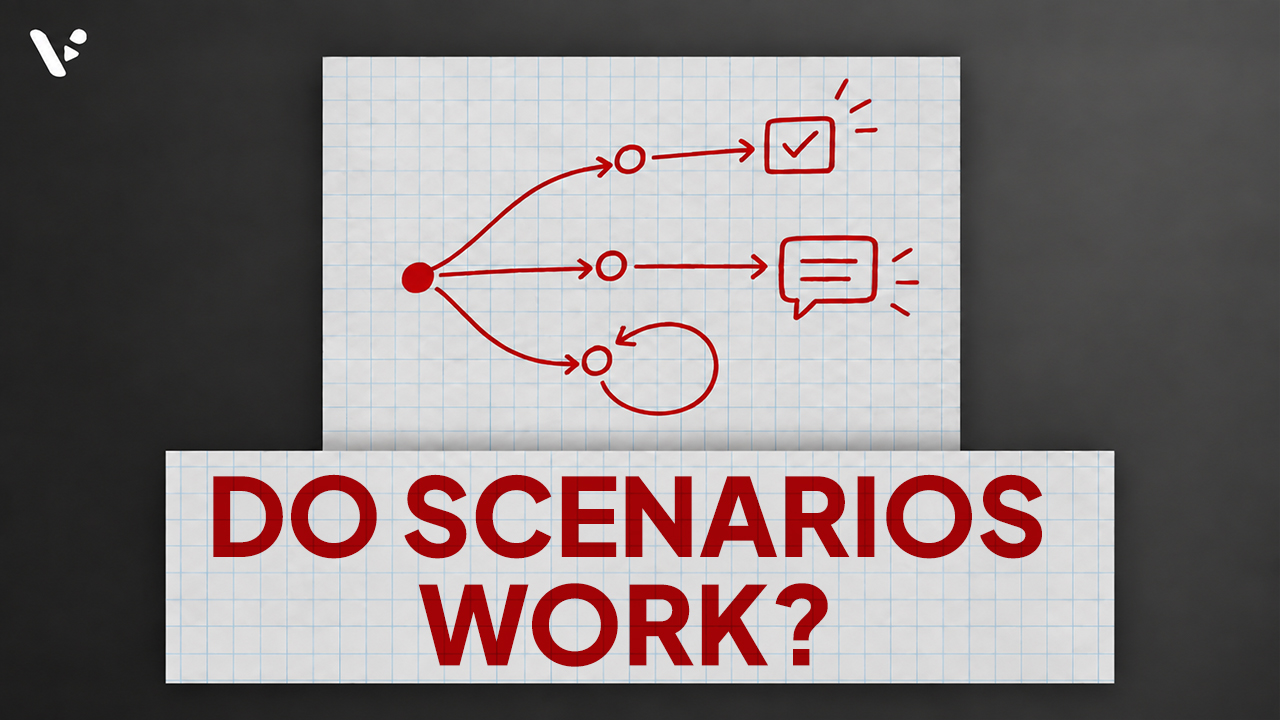
Quick Answer: Yes, scenario-based learning videos can be effective, especially when learners need to practice making decisions or applying knowledge in a realistic situation. Research shows that scenario-based and branching videos can improve knowledge, motivation, engagement, and, in some cases, decision-making, but they don’t consistently outperform well-designed linear training videos. The format works best when learners already have enough background knowledge to understand the situation, essential information isn’t hidden inside branches, and the video pauses while they make a choice. Scenario-based training videos are useful because they create structured practice, not because branching or interactivity automatically produces better learning.
What does research say about scenario-based learning videos?
Direct research on scenario-based learning videos is still fairly limited, especially in corporate training. Most of the strongest studies come from higher education and health-professions education, so L&D teams should be careful about assuming every effect will transfer directly to the workplace.
| Study | What it tested | What it found |
|---|---|---|
| Lien et al., 2025: decision-based branching video learning | Branching trauma-care video vs. lecture instruction with 95 nurses | Knowledge improved significantly and remained higher 12 weeks later; clinical reasoning was higher but not significantly so |
| Lacey et al., 2024: interactive branching videos | Interactive branched videos vs. linear videos in undergraduate biology | Both formats improved knowledge; branching didn’t produce larger learning gains, but students often found it more engaging |
| Özsaban et al., 2026: scenario-based animated training | Scenario-based animated video vs. conventional skills video with 104 nursing students | Both improved knowledge similarly; the scenario group reported higher motivation and more positive attitudes |
| Baruh et al., 2026: scenario-based videos and cognitive bias | Brief scenario-based videos designed to reduce cognitive bias with 1,038 teachers and learners | The intervention reduced biased decisions overall, with stronger effects and evidence of transfer among teachers |
The direct comparisons suggest that scenario-based video may be more reliable for changing the learning experience and quality of practice than for producing dramatically higher factual knowledge scores. The strongest gains appear when learners are doing something with what they know, such as making decisions, solving problems, or applying judgment in context.
Branching videos work better for application than for teaching everything from scratch
The 2024 Lacey study comparing interactive branching and linear videos shows what can go wrong when branching video is used as the main vehicle for teaching core content.
Researchers randomly assigned biology students to interactive, decision-based videos or linear videos covering the same material. Both groups improved their knowledge, but the branching videos didn’t produce significantly greater learning gains.
The student feedback was more revealing. In the first cohort, 62% said the decision-based videos were more engaging and 56% considered them more useful than linear video, but only 28% thought the material was presented logically. Students also worried that choosing one branch meant they might miss important content.
If a learner has to guess which path contains information they’ll later be tested on, the branching structure is getting in the way.
The researchers later used branching video as a problem-solving and consolidation activity after learners had already received the relevant core material. That version was received much better. Ninety-three percent said the interactive videos were more useful than the linear version, and 74% wanted more interactive videos in the future.
For L&D teams, the practical rule is to teach or scaffold the necessary knowledge first, then use scenarios to make people apply it. A learner can encounter new information inside a scenario, but essential policies, concepts, or procedures shouldn’t disappear because they picked Option A instead of Option B.
That fits the guidance in our article on what makes a good training video, where practice and application are treated as separate from basic content delivery.
Scenario-based training can improve the experience even when test scores don’t change
A 2026 randomized trial comparing scenario-based animation with conventional skills video assigned 104 nursing students to either a scenario-based animated video or a conventional skills video about range-of-motion exercises.
Knowledge improved significantly in both groups, with no significant difference between them. The scenario group, however, reported significantly higher motivation and more positive attitudes toward e-learning.
Motivation isn’t the same thing as retention or transfer, so that result shouldn’t be stretched further than the study supports. But learner experience still matters. If two approaches teach the material about equally well and one is easier to engage with, that can be a legitimate reason to use it.
Training doesn’t become better because everyone hates sitting through it.
Can scenario-based learning videos improve transfer and decision-making?
Organizations ultimately care about whether training changes decisions or behavior on the job. A learner can pass a quiz and still make the wrong decision later.
Our guide to measuring training video effectiveness separates immediate learning from retention, transfer, workplace behavior, and business outcomes for that reason.
A large 2026 randomized controlled trial gives us useful evidence here. In Baruh, Cemalcilar, and Stoycheff’s study of scenario-based videos and cognitive bias, 1,038 teachers and learners across multiple countries watched realistic situations that could trigger a biased judgment. The intervention group received additional information intended to prompt a less biased decision.
The intervention significantly reduced biased decisions overall. The effect was much stronger among teachers than learners, and teachers also showed evidence of transfer to an unrelated later task. Learners didn’t show that same transfer effect, and language also affected results.
This wasn’t a corporate training study, so it doesn’t prove that a scenario video will improve sales calls, safety behavior, or manager decisions. It does show that the intervention changed actual decisions rather than only recall.
The differences between teachers and learners also matter. They suggest that prior knowledge, experience, language, and learner characteristics can affect whether a scenario changes behavior beyond the immediate lesson.
Pause the video when learners have to make a decision
When a scenario reaches a question, stop giving the learner new information.
Ploetzner’s meta-analysis of interactive educational video combined 17 studies and 22 effect sizes. Videos with learning-focused interactive features, usually questions or tasks, significantly outperformed videos without those features, with an overall effect size of Hedges’s g = 0.522.
There was an important catch. When the video continued playing while learners were trying to complete the interactive task, split attention impeded learning.
So don’t make someone read a decision prompt while a character keeps talking, new information appears, and the scene continues changing behind the question. Pause the video, let the learner think, collect the response, then continue.
A 2025 experiment on navigation and self-explanation in interactive video also found that adding navigation controls and self-explanation prompts didn’t automatically improve learning. The quality of learners’ responses mattered.
How do you design an effective scenario-based learning video?
| Design choice | What to do |
|---|---|
| Use scenarios for application | Give learners the background they need, then ask them to apply it to a realistic problem |
| Keep critical information outside optional branches | Don’t make one choice determine whether the learner sees a rule, policy, or concept everyone needs |
| Make choices job-relevant | Ask learners to make decisions that resemble the judgment they’ll need at work |
| Pause at decision points | Stop presenting new information while the learner considers the question |
| Give useful feedback | Explain why a choice works, what its consequences are, and what the learner should consider next time |
| Measure the right outcome | If the goal is better judgment or job performance, don’t judge success only with a recall quiz |
Scenario-based learning videos make the most sense when the learner needs to interpret a situation rather than simply remember a fact. Good examples include manager conversations, customer service, compliance decisions, sales practice, safety situations, and other cases where context changes what the right response looks like.
For a fixed procedure, a straightforward demonstration may be more efficient. Our guide to creating video SOPs for scalable L&D training makes the same distinction: use the format that matches the task.
Are scenario-based learning videos worth using?
Yes, when the learning objective calls for practice, judgment, or decision-making. For fixed procedures or straightforward information delivery, a simpler format may be the better choice.
FAQ
Scenario-based learning videos work best when learners need to practice judgment, decision-making, or applying knowledge in context. They’re especially useful for areas like management, compliance, customer service, sales, and safety training. For simple procedures or straightforward information, a linear video may be more efficient.
Beginners can learn from scenario-based videos, but they usually need enough background knowledge to understand the choices they’re making. Important concepts, rules, or policies shouldn’t be hidden inside optional branches. A better approach is to teach or scaffold the basics first, then use scenarios for practice.
Start by measuring the outcome the training is supposed to change, such as knowledge, decision quality, retention, transfer, or job performance. Immediate quiz scores can be useful, but they don’t show whether learners will apply the training later. For decision-based training, follow-up assessments or workplace behavior measures are usually more informative.

May Horiuchi
May is a Content Specialist and AI Expert for Visla. She is an in-house expert on anything Visla and loves testing out different AI tools to figure out which ones are actually helpful and useful for content creators, businesses, and organizations.