
A lot of companies used to hire a video agency for a handful of major projects each year: a launch film, a customer story, or a brand campaign. Now, those same companies also need training videos, SOPs, product explainers, onboarding modules, sales clips, internal updates, and localized versions.
That recurring work creates a different problem. Agencies still make sense for high-end productions, but they aren’t always the best way to create videos that need to be published quickly, revised often, and scaled across teams.
Quick answer: When should you use Visla instead of a video agency?
Use a video agency for signature productions that need original filming, interviews, actors, locations, or deep creative direction.
Use Visla for recurring business videos that your team needs to create, update, review, and republish regularly. Visla is especially useful for training, onboarding, SOPs, product walkthroughs, internal communications, sales enablement, and customer education.
What is Visla?
Visla is an all-in-one video creation platform for businesses. Teams can use it to record, generate, edit, review, brand, and share videos without moving the project through several disconnected tools.

Start with the materials you already have
With Visla’s AI Video Agent, you can turn an idea, script, webpage, recording, footage, audio file, PDF, or PPT into an editable video draft.
That matters for teams that already have useful information but don’t have time to rebuild it as video from scratch. A product team can turn a help document into a walkthrough. An L&D team can turn a slide deck into a training video. A marketing team can turn a blog post into a short explainer.
Review the full scene plan before generating more
AI Director Mode gives teams more control when they want to use generated visuals. You can review the full list of scenes before committing to the final output and decide which scenes you want to generate AI clips for.
You also don’t have to regenerate an entire video because one scene misses the mark. You can revise an individual scene as needed: update the voiceover, adjust the AI clip, or add an entirely new scene as needed.
Update videos as your information changes
The scene-based editing system streamlines the entire video editing process. Teams can move, trim, merge, and revise individual scenes, rather than having to scrub through a long, complex timeline. That means teams can easily update business videos scene-by-scene and not produce an entirely new video every time a policy, process or product feature changes.
What does a video agency do?
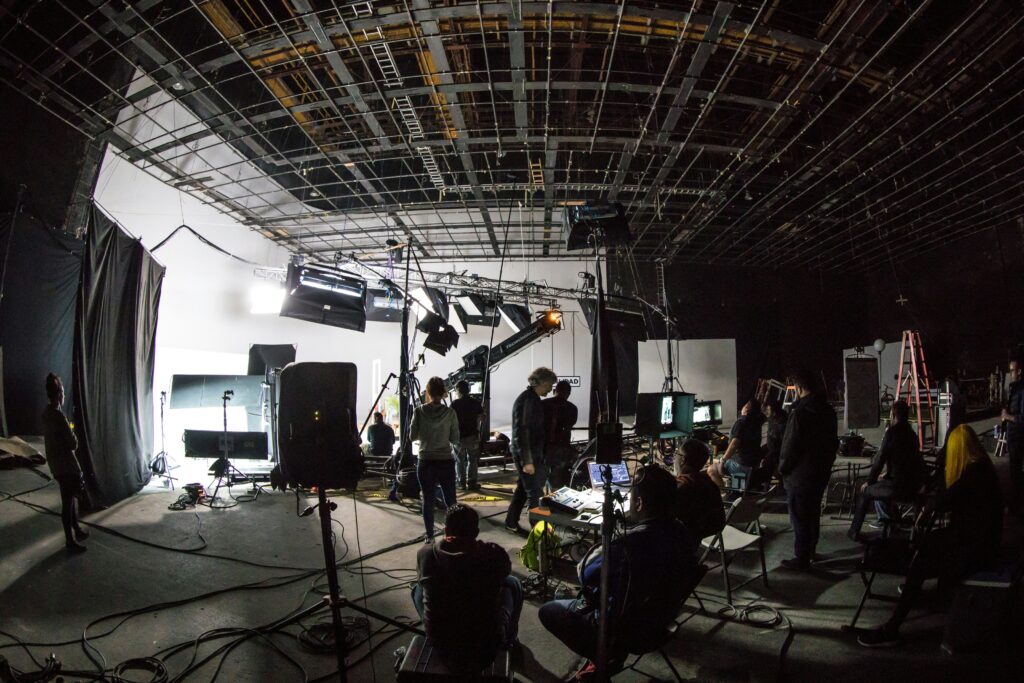
A video agency is a project-based creative partner. Depending on the scope, an agency may handle concepting, scripting, storyboarding, casting, location planning, filming, sound, editing, animation, and motion graphics.
That process can produce excellent work. It can also require a substantial budget and a long timeline.
According to Clutch’s 2026 video production pricing guide, projects reviewed on its platform typically cost less than $10,000, while the average reviewed agency project cost is $42,280.92. Clutch also reports that most agencies charge between $100 and $149 per hour. Costs vary based on factors such as runtime, crew size, filming locations, actors, and editing requirements.
Those costs may be reasonable for a flagship campaign. They’re harder to justify when a company needs a steady stream of videos for everyday work.
Why this comparison matters now
Business video is no longer just a nice-to-have.
According to Wistia’s 2026 State of Video report, 76% of companies create at least one video per month. More than half regularly create educational videos, social videos, product videos, and webinars.
Vidyard’s business video benchmark report points in the same direction. Vidyard users created 943,305 videos in 2024, up 88% from the previous year.
The challenge isn’t making one video. It’s building a process that can keep up with recurring demand.
Cost: agency pricing can become difficult to scale
Agencies price around project scope
Agency pricing makes sense when the work requires a crew, original filming, locations, advanced editing, or custom creative direction.
But frequent variations can add up. A training video may need separate versions for different departments. A sales explainer may need new messaging for different industries. A product tutorial may need revisions after a software update. Each version can require more coordination, review time, and budget.
Some agencies offer retainers or templated packages. Those options can help, but each new deliverable still consumes production and project-management resources.
Visla uses a software-based model
Visla’s pricing is based on plans and credits. Credit use varies depending on the workflow. A straightforward text-based project uses fewer credits than a video built with more visual analysis or generated footage.
That gives teams more flexibility. They can reserve expensive production work for videos that need it while creating routine explainers, updates, and tutorials internally.
Time: routine updates shouldn’t require a full production cycle
Complex shoots take time for good reasons
Agency production often includes discovery, scripting, scheduling, filming, editing, feedback, and approvals. Clutch reports a typical timeline of five months for video production projects reviewed on its platform.
That may be appropriate for a polished campaign. It’s a poor fit for an onboarding video that became inaccurate after a product update.
Scene-level edits make small changes manageable
A product team may only need to replace one screenshot. HR may need to update a single policy line. An L&D team may need to revise one step in a software tutorial.
With Visla, those changes don’t require a full restart. Teams can edit the relevant scene, update the wording or visual, and publish a revised version.
Consistency: brand drift becomes more obvious as output grows
Real workflows get messy
Brand inconsistency isn’t usually caused by one dramatic mistake. It comes from small differences across many projects.
A product team may use last quarter’s screenshots. HR may add an outdated logo to an onboarding module. A regional sales team may send an old intro file to a freelancer. Another department may choose a different voiceover style because it can’t find the approved version.
These problems become more common as more people create video.
Salesforce research on customer expectations found that 79% of customers expect consistent interactions across departments, but 55% feel like they’re communicating with separate departments rather than one company.
A shared workspace reduces variation
With Visla Workspaces and Teamspaces, teams can keep footage, projects, comments, approvals, and shared assets in one place. Teams can also manage access and organize private stock footage for specific departments or projects.
Centralizing the workflow doesn’t replace clear brand rules. It makes those rules easier to follow.
Control: external handoffs can slow down simple changes
Agency work usually involves external review loops. A team requests a change, the agency schedules the work, stakeholders review the revision, and someone sends back another round of comments.
That process is manageable for a major campaign. It becomes frustrating when the video is an SOP, internal announcement, or product tutorial that needs a small update.
This isn’t only a software-company talking point. Reuters reported in May 2026 that some global companies are using AI to bring more advertising work in-house, reduce turnaround times, and rely less heavily on external agencies.
Internal production gives teams more control over practical work. HR can revise a training video after a policy update. Product marketing can change a feature explainer before a release. Customer success can correct an outdated tutorial without opening a new external project.
Scalability: versioning is where the models diverge
Agencies can scale production. The issue is what happens when the number of versions grows.
Imagine a company needs one training video for ten regions, with different languages, policies, and examples. Or a sales team needs industry-specific product explainers for healthcare, finance, education, and retail. Or a software company needs to update tutorial videos every time the interface changes.
In a traditional production model, each variation may introduce added scope, approvals, editing time, and fees.
With Visla, teams can start with a base video and revise the relevant scenes. They can update messaging, swap visuals, adjust branding, translate content, and create new versions without rebuilding the project from zero.
Quality: use the right production standard for the job
A good agency can create a more cinematic, bespoke video than a software platform. That matters when the video is a major public-facing asset.
A brand campaign may benefit from original cinematography. A customer story may need a skilled interview team. A commercial may need actors, a location shoot, and detailed art direction.
But a five-minute SOP video has a different job. It needs to show the right steps. A compliance video needs to be accurate. A product walkthrough needs to match the current interface. An internal update needs to reach employees while the information is still relevant.
The right production standard depends on the purpose of the video.
How to choose between Visla and a video agency
| Choose a video agency when… | Choose Visla when… |
|---|---|
| You need a high-end brand film or commercial | You need recurring business videos |
| Original filming is central to the project | Existing materials can become the starting point |
| You need actors, interviews, locations, or a crew | Your team needs to create videos internally |
| Creative direction is the main value | Speed and ease of revision matter |
| The finished video will have a long shelf life | The content changes regularly |
| You’re producing a major campaign asset | You need versions for teams, regions, or languages |
The practical approach is to use agencies selectively. Save the larger budget and longer production cycle for videos where that investment makes a real difference. Use Visla for the recurring work that needs to stay current as your business changes.
FAQ
Costs vary widely by scope. Clutch’s 2026 pricing guide says reviewed video production projects on its platform typically cost less than $10,000, while the average reviewed agency project cost is $42,280.92. Crew size, filming locations, runtime, actors, editing requirements, and motion graphics can all affect the final price.
For many training videos and SOPs, yes. Visla is well suited to videos built from existing documents, presentations, screen recordings, and scripts. Teams can also update individual scenes when a process changes instead of commissioning a new production.
Teams can revise specific scenes, replace visuals, update wording, adjust branding, and create new versions without starting over. Visla also supports video translation and multiple-language creation, which can make regional adaptations easier to manage.

May Horiuchi
May is a Content Specialist and AI Expert for Visla. She is an in-house expert on anything Visla and loves testing out different AI tools to figure out which ones are actually helpful and useful for content creators, businesses, and organizations.